
On 12 November 2026, ONC and CMS launched hands-on testing for electronic prior authorization, ahead of the payer API requirements that start in 2027. Expressions of interest close on 20 November. Most practices won’t be in the first round, so here’s what the testing covers, what stays on fax, and how your fax server logs show where to start.
If you run fax for a hospital, a clinic or a billing team, prior authorization is probably the biggest stream your fax server handles. The federal plan is to move a good share of it onto APIs. This week’s announcement is a sign the plan is getting real, and also a fairly honest admission that the plumbing isn’t ready everywhere yet.
What ONC and CMS announced
The Office of the National Coordinator for Health IT (ONC), working with CMS, announced a series of industry testing events for end-to-end electronic prior authorization. Payers, providers, hospitals, EHR developers and intermediaries are invited to test their own workflows across connected systems, in production-like environments, and find the gaps before wider rollout.
The key details from the 12 November release:
- 10 to 12 week sprints. Testing runs in focused sprints, aimed at high-volume and high-priority clinical services.
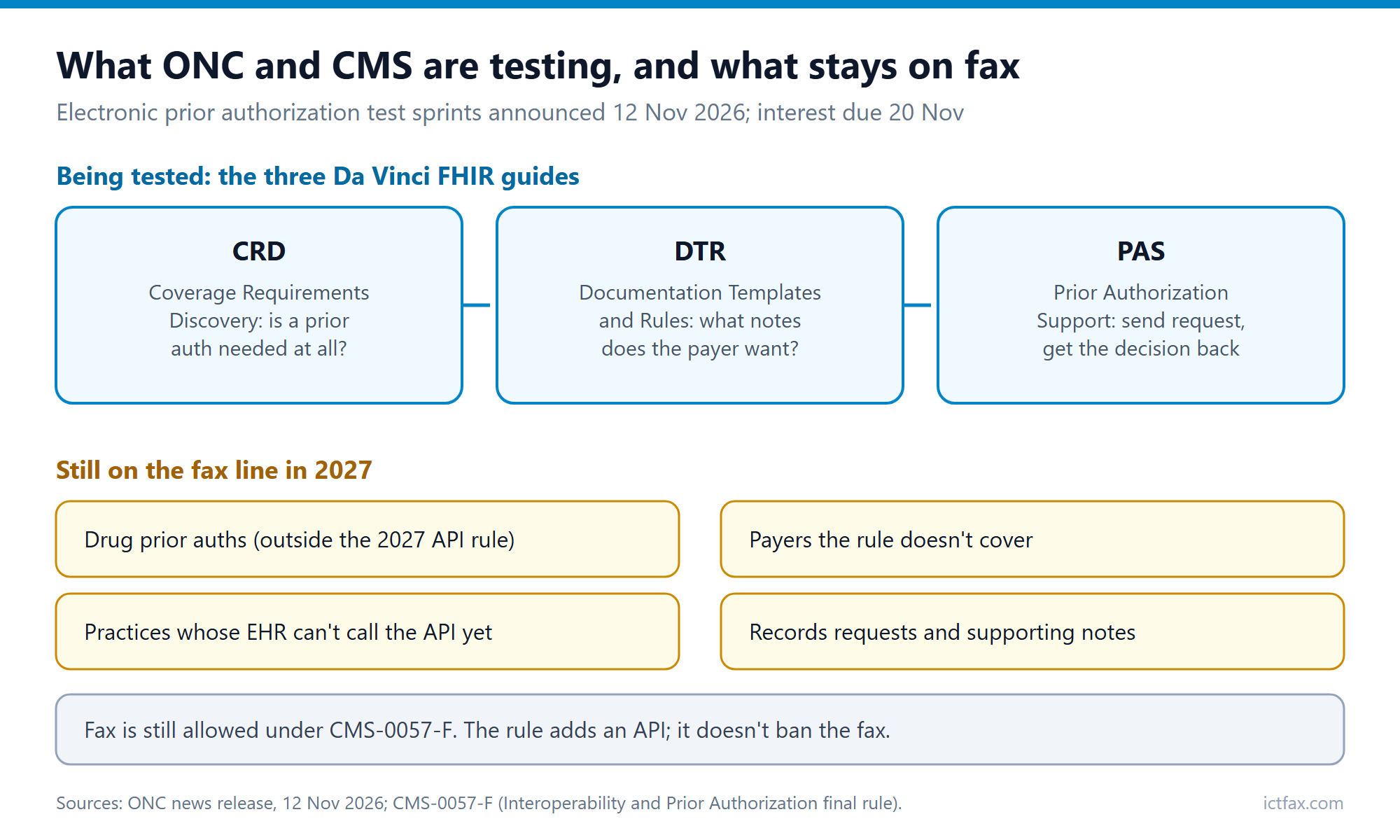
- Three HL7 FHIR Da Vinci guides. Coverage Requirements Discovery (CRD), Documentation Templates and Rules (DTR) and Prior Authorization Support (PAS).
- MITRE and Drummond Group run it. The MITRE-led Health FFRDC and Drummond Group handle recruitment, readiness and matching partners. Drummond operates FHIRplace, a virtual environment for testing with partners.
- Interest by 20 November. First-round space is limited. ONC says it welcomes organizations of all sizes, including smaller ones and those serving rural communities, and more rounds may follow.
- It’s voluntary. Taking part isn’t certification under the ONC Health IT Certification Program, and it isn’t a finding that you comply with CMS requirements.
Tom Keane, the National Coordinator, said regulations and standards “have laid important groundwork for ePA, but our work is not done.” That’s the useful reading for anyone running fax: the agencies expect gaps, and they’re testing to find them.
Where this fits in the 2027 rule
The testing supports the CMS Interoperability and Prior Authorization final rule, CMS-0057-F. It requires Medicare Advantage organizations, state Medicaid and CHIP fee-for-service programs, Medicaid and CHIP managed care plans, and qualified health plan issuers on the federal exchanges to run a Prior Authorization API, with compliance dates starting in 2027. The API has to tell a provider whether an item or service needs prior auth, what documentation the payer wants, and return the decision.
Two things in that rule matter a lot for fax planning:
- Drugs are out of scope. The API requirement doesn’t cover prior authorization for drugs. That’s a separate proposal, which we wrote about when CMS-0062 came out, and it’s still only a proposal.
- Fax isn’t banned. The rule adds an electronic route. It doesn’t stop anyone from sending or receiving a prior auth by fax, and payers can still send decisions by fax, portal, mail or phone.
Some parts are already live. Since 2026, most impacted payers have had to decide expedited requests within 72 hours and standard requests within seven calendar days, and give a specific reason for a denial no matter how the request arrived. A faxed request is on the same clock as an API request.
What will still arrive by fax in 2027
Even if every covered payer turns its API on in January, a large part of your prior auth fax traffic will keep coming. Think about:
- Drug prior authorizations, which the 2027 API doesn’t cover.
- Payers outside the rule, such as many employer-sponsored commercial plans.
- Practices whose EHR can’t call a payer’s API yet, or whose vendor hasn’t switched the feature on.
- Supporting clinical notes, records requests and appeals that travel alongside an authorization.
That’s the reason the testing matters to a fax team. The faster the API lanes work, the more of your fax queue becomes the exceptions, and exceptions are where a missed page or a slow handoff hurts most. We made a similar point about the 2026 decision deadlines: a fax that sits unread still counts against the clock.
Count your prior auth faxes by payer before January
You don’t need to join a sprint to get ready. You need to know which payers send and receive most of your prior auth paperwork, and your fax server already holds that answer.
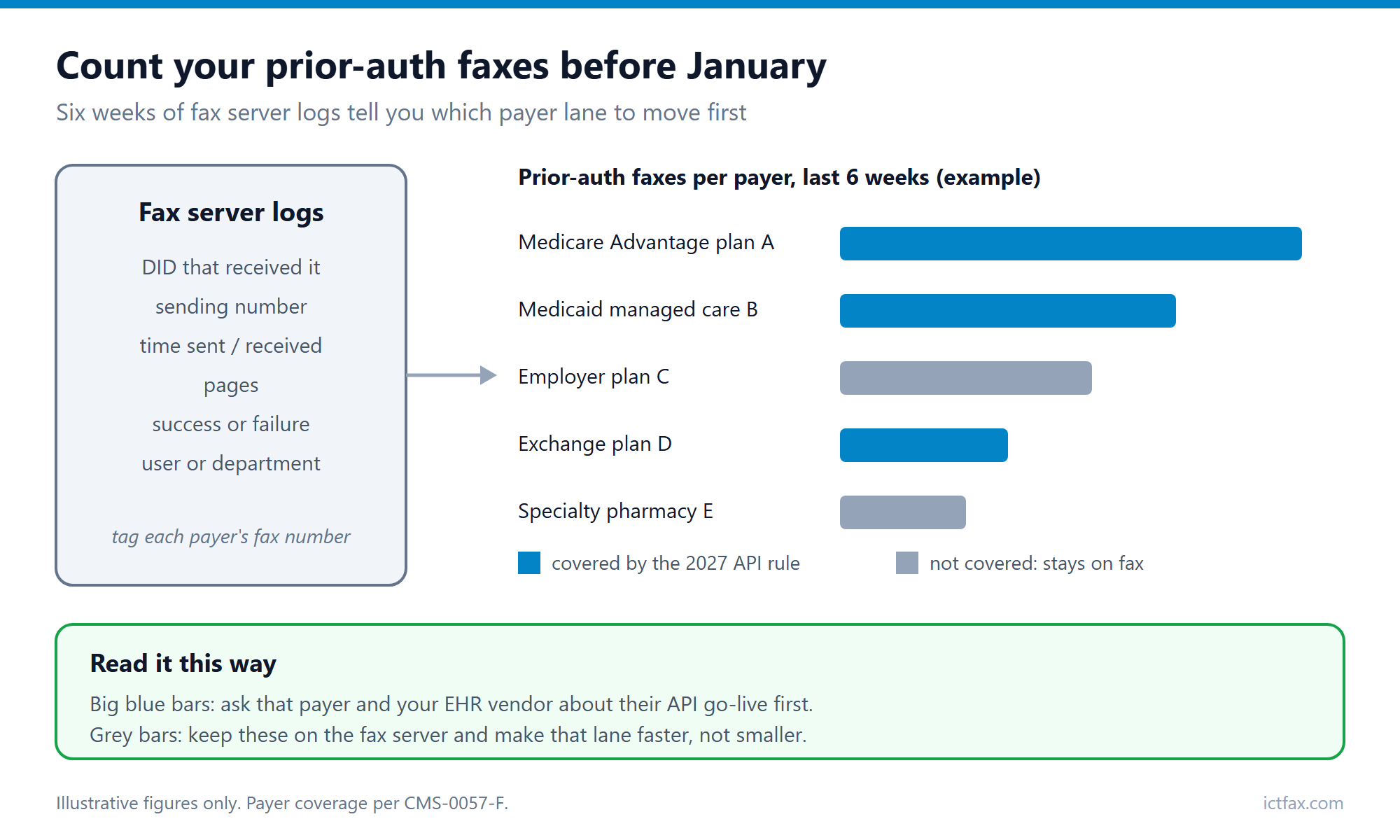
- Tag each payer’s fax numbers. Build a short list of the prior auth fax numbers for your top payers. Mark each one as covered by CMS-0057-F or not.
- Pull six weeks of fax records. In ICTFax, the CDR and reporting screens show each fax with its number, time, pages and result. If you assign a DID to the prior auth team, their traffic is easy to separate from everything else.
- Rank by volume. The covered payers with the most faxes are where an API saves you the most work. Ask those payers, and your EHR vendor, when their Prior Authorization API goes live and what you need to switch it on.
- Keep the rest fast. The payers that stay on fax become your exception lane. Route those faxes straight to the right person or inbox, check failed sends daily, and keep the transmission record with the authorization.
- Re-run the count each quarter. As payers go live, your fax volume per payer should fall. If one doesn’t move, that’s the conversation to have with that payer or your vendor.
If prior auth paperwork goes out by email today, email to fax keeps that habit while still giving you a central record of every page sent. And because ICTFax is self-hosted, those logs stay on your own server, under your own retention rules.
Should you put your hand up for testing?
If you’re a larger provider, a payer or an EHR developer, probably yes. The sprints are exactly the place to find out your systems disagree about a documentation template before patients feel it. If you’re a small practice, the release explicitly invites you too, and the honest benefit is learning what your EHR vendor can and can’t do yet. Either way, the deadline is 20 November and first-round places are limited.
For everyone else, the plan is simpler. Count your fax lanes, push the busy covered ones toward the API, and make the fax lane that’s left as dependable as you can.
Frequently asked questions
What did ONC and CMS announce on 12 November 2026?
A series of voluntary industry testing events for end-to-end electronic prior authorization, run as 10 to 12 week sprints in production-like environments, using the HL7 FHIR Da Vinci CRD, DTR and PAS guides. Expressions of interest for the first round are due by 20 November.
Does the 2027 prior authorization rule ban fax?
No. CMS-0057-F requires covered payers to run a Prior Authorization API, but it doesn’t stop providers or payers from using fax. Decisions can still be sent by fax, portal, mail or phone.
Are drug prior authorizations part of the 2027 API requirement?
No. The API requirement in CMS-0057-F excludes drugs. A separate proposed rule, CMS-0062, would add drug prior authorization, but it isn’t final.
Which payers have to offer a Prior Authorization API?
Medicare Advantage organizations, state Medicaid and CHIP fee-for-service programs, Medicaid and CHIP managed care plans, and qualified health plan issuers on the federally facilitated exchanges. Many employer-sponsored commercial plans fall outside the rule.
Does joining the testing make my software certified or compliant?
No. ONC says participation isn’t certification under its Health IT Certification Program and isn’t a determination of compliance with CMS requirements.
How can a fax server help with the move to electronic prior authorization?
Its logs show which payers send you the most prior auth paperwork, so you know where an API saves the most work. It then keeps carrying the exceptions, with a record of every page sent and received.