
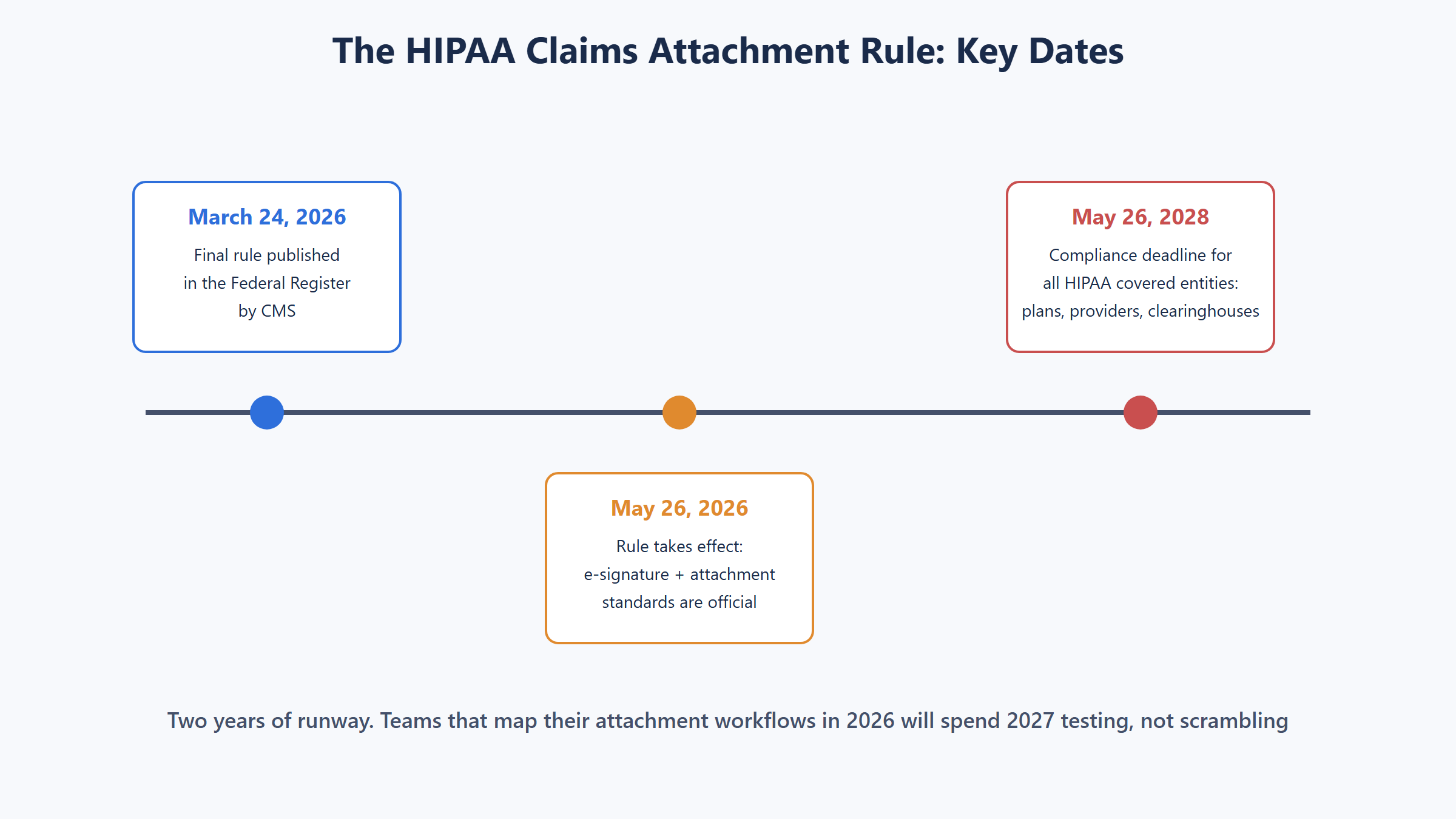
The waiting is over. CMS published the final HIPAA claims attachment rule in the Federal Register on March 24, 2026, it took effect on May 26, and every covered entity now has until May 26, 2028 to comply. The rule sets national standards for electronic claims attachments and, for the first time, electronic signatures on those attachments. If your organization moves clinical documents by fax, this rule doesn’t kill that workflow. It does raise the bar for what your fax platform has to prove.
What the Rule Actually Requires
Claims attachments are the supporting documents payers request before adjudicating a claim: clinical notes, imaging reports, lab results, operative summaries. Until now there was no national standard for sending them electronically, so the industry defaulted to mail and fax, and payers pended millions of claims waiting on paper.
The final rule names the X12 275 transaction and HL7 CDA templates as the standards for transmitting attachments, and it adopts e-signature standards so a payer can verify who signed a document and that nobody altered it afterward. Health plans, clearinghouses, and providers who transact electronically all fall under it.
Here’s the part that matters for fax users: the rule standardizes how attachments travel between systems that both speak X12. It doesn’t outlaw other channels. A huge share of attachment requests will keep flowing to organizations that won’t have 275 capability by 2028, and for those exchanges, secure digital fax remains the workhorse. What changes is the definition of acceptable. A fax machine spitting PHI into an open tray with no audit trail was always risky. After 2028, with payers auditing attachment workflows against the new standards, it becomes indefensible.
Where HIPAA Compliant Fax Software Fits
Think of the post-2028 attachment landscape as two lanes. Lane one is the X12 275 rail between systems that both support it. Lane two is everything else, and lane two is where a modern fax server earns its keep.
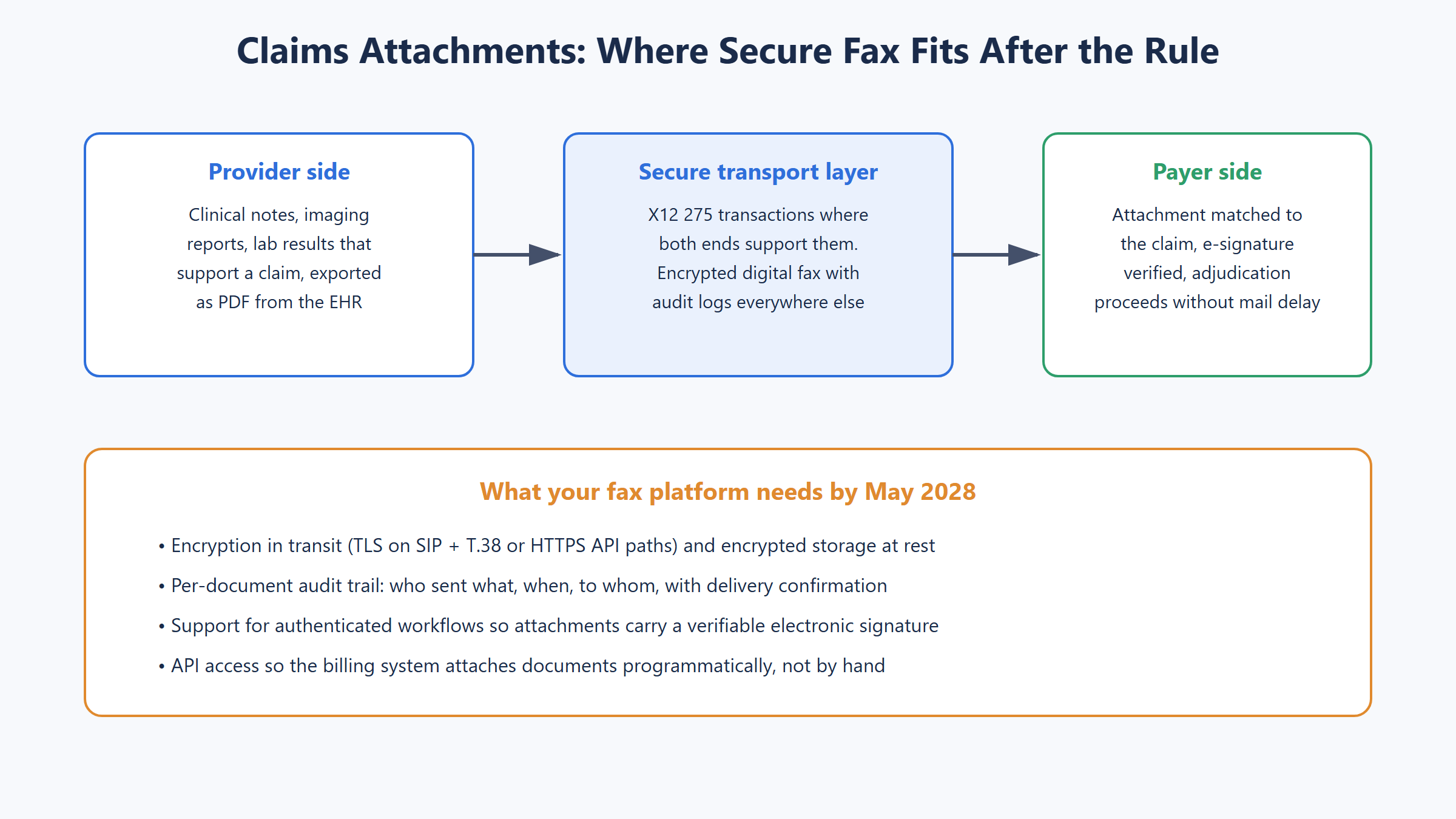
The requirements aren’t mysterious. Encryption in transit, whether that’s TLS on the SIP leg carrying T.38 or HTTPS on the API path. Encrypted storage at rest. A per-document audit trail that records who sent what, when, to whom, and whether it arrived. And integration hooks, because the rule’s whole point is killing manual re-keying: your billing system should attach documents through an API, not a staff member standing at a machine.
ICTFax was built for exactly this shape of workflow. It’s a FreeSWITCH based fax server that moves documents as PDFs over T.38, logs every transmission with timestamps and delivery results, and exposes a REST API so attachments flow programmatically from the systems that generate them. No paper stage, no output tray, no gap in the audit trail.
My honest read on the two-year runway: it’s generous, and that’s a trap. The organizations that got burned by past HIPAA transaction deadlines were the ones that treated the runway as a snooze button. Mapping your attachment workflow takes a week. Doing it in 2026 means 2027 is for testing and 2028 is boring. Doing it in early 2028 means paying rush rates to consultants.
A Practical Checklist for the Next Six Months
Start with an inventory. List every point where clinical documents leave your organization for a payer, and note the channel: portal upload, mail, fax, clearinghouse. Most groups find fax carries more volume than anyone guessed.
Then grade the fax layer. Analog machines on POTS lines fail the audit-trail test outright. Cloud fax services pass technically but park your PHI with a third party. A self-hosted fax server passes the technical tests and keeps documents on your own infrastructure, which shortens the vendor-risk section of your next security review. You can try a live demo to see the logging and API side before committing anything.
Finally, talk to your top five payers about their 275 timelines. If a payer that sends you a third of your attachment requests will support X12 275 by 2027, plan that integration. For the long tail that won’t, make sure the fax path is encrypted, logged, and API-driven. That combination, not any single channel, is what compliance will look like.
FAQ
What is the HIPAA claims attachment rule?
It’s the CMS final rule adopting national standards for electronic claims attachments (X12 275 with HL7 CDA documents) and electronic signatures. It was published March 24, 2026, took effect May 26, 2026, and sets a compliance deadline of May 26, 2028 for HIPAA covered entities.
Does the rule ban fax for claims attachments?
No. It standardizes electronic attachment transactions between systems that support them. Fax remains a lawful channel, but the practical expectation shifts to secure digital fax with encryption, audit logs, and delivery confirmation rather than paper machines.
What makes fax software HIPAA compliant?
Encryption in transit and at rest, role-based access controls, per-document audit logging with delivery confirmation, and secure storage. Self-hosting adds control: PHI stays on your infrastructure instead of a cloud vendor’s.
What is an X12 275 transaction?
It’s the standard electronic envelope for sending additional documentation that supports a claim, carrying HL7 CDA clinical documents inside. The new rule makes it the named standard for attachment exchange between capable systems.
What should healthcare organizations do before May 2028?
Inventory every attachment exit point, upgrade any analog fax to a logged digital fax server, ask major payers for their X12 275 timelines, and wire attachments into the billing system through an API so nothing depends on manual handling.